Currently Empty: R0.00

What Ultrafiltration Removes: A Complete Guide
One of the first questions people ask before installing an ultrafiltration (UF) system is, “What exactly does it remove from water?” Understanding what ultrafiltration removes helps homeowners, businesses and industries choose the right water treatment solution for their needs.
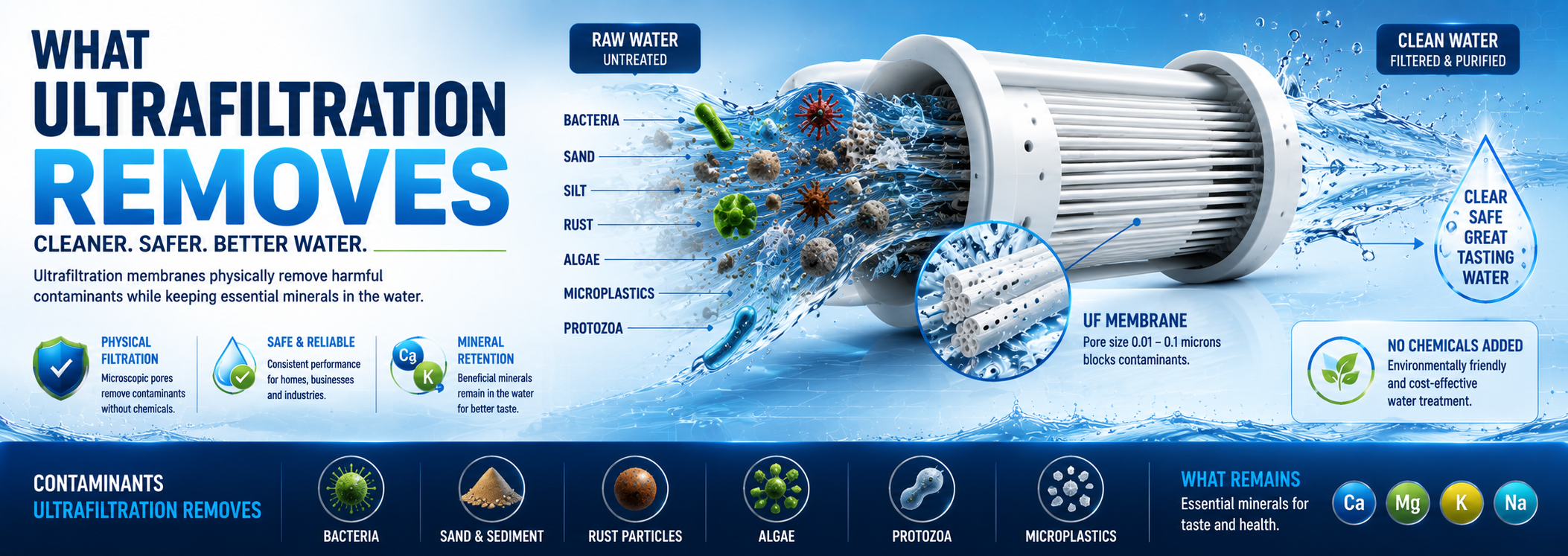
Ultrafiltration uses a physical membrane with microscopic pores to separate unwanted contaminants from water. Unlike some other filtration technologies, it removes many harmful particles while allowing naturally dissolved minerals to remain. This balance makes ultrafiltration an excellent option for improving water quality without significantly changing the water’s natural composition.
How Ultrafiltration Removes Contaminants
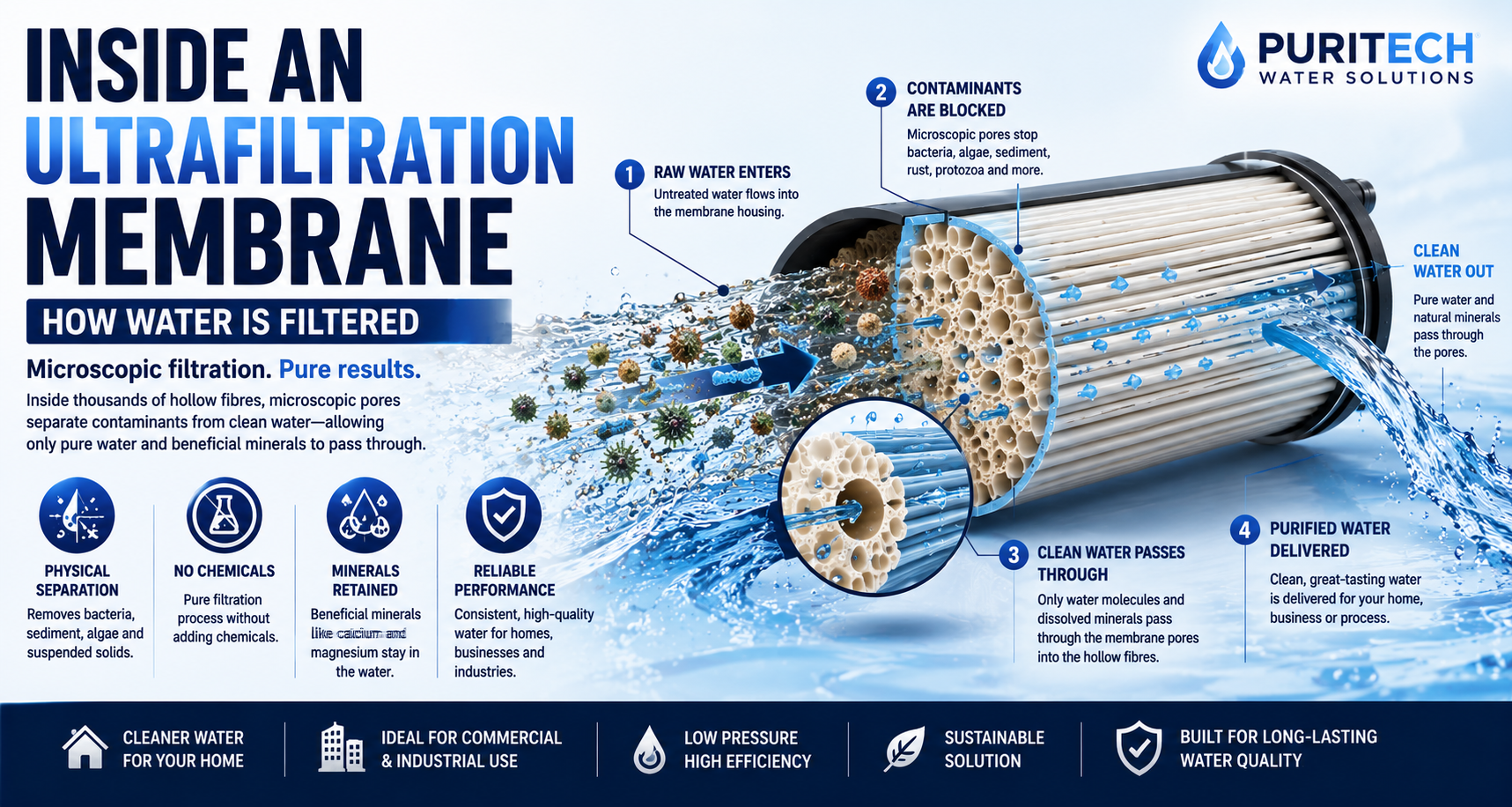
An ultrafiltration membrane contains microscopic pores that typically measure between 0.01 and 0.1 microns.
As water flows through the membrane under pressure, particles that are larger than the pores remain behind, while clean water and dissolved minerals pass through.
Because the process relies on physical separation rather than chemicals, ultrafiltration provides consistent filtration without adding substances to the water.
What Ultrafiltration Removes
An ultrafiltration system removes many contaminants commonly found in municipal, borehole and surface water.
These include:
Suspended Solids
The membrane effectively removes the following:
- Sand
- Silt
- Mud
- Fine sediment
- Rust particles
Consequently, the water becomes much clearer.
Bacteria
One of the biggest advantages of ultrafiltration is its ability to remove most bacteria that are larger than the membrane pores.
This significantly improves microbiological water quality.
Protozoa
Ultrafiltration also removes many harmful protozoa that may be present in untreated water sources.
Algae
Microscopic algae and many organic particles are effectively retained by the membrane.
This improves both appearance and water quality.
Microplastics
Modern ultrafiltration membranes remove many microplastic particles that may be present in water supplies.
Turbidity
Ultrafiltration greatly reduces turbidity by removing suspended matter responsible for cloudy water.
As a result, the treated water appears cleaner and more appealing.
What Ultrafiltration Does Not Remove
Although ultrafiltration removes many physical contaminants, it is not designed to remove every type of impurity.
Generally, ultrafiltration does not remove:
- Dissolved salts
- Total Dissolved Solids (TDS)
- Calcium
- Magnesium
- Sodium
- Dissolved heavy metals
- Nitrates
- Most dissolved chemicals
If these contaminants exceed acceptable levels, additional treatment technologies may be required.
Why Minerals Stay in the Water
Many people choose ultrafiltration because it allows beneficial minerals to remain.
Minerals such as calcium and magnesium exist as dissolved ions that are much smaller than the membrane pores.
Therefore, they pass through the membrane together with the purified water.
Does Ultrafiltration Remove Chlorine?
Not by itself.
Chlorine remains dissolved in water, so it usually passes through the ultrafiltration membrane.
For this reason, activated carbon filtration is often installed before or after ultrafiltration when chlorine removal is required.
Does Ultrafiltration Remove Viruses?
Ultrafiltration removes some larger viruses.
However, virus removal depends on several factors, including:
- Virus size
- Membrane specification
- Water quality
- System design
In applications where complete virus control is required, additional disinfection methods such as ultraviolet (UV) treatment or other appropriate technologies may be recommended.
Water Sources Suitable for Ultrafiltration
Ultrafiltration is commonly used for:
- Municipal water
- Borehole water (following water analysis)
- Surface water
- Rainwater harvesting systems
- Commercial process water
- Industrial pre-treatment
Selecting the correct system depends on the quality of the incoming water.
Benefits of Removing These Contaminants
Removing suspended contaminants provides many advantages.
These include:
- Cleaner drinking water
- Improved taste and appearance
- Better protection for downstream equipment
- Reduced microbiological contamination
- Lower maintenance requirements
- Longer equipment lifespan
Consequently, ultrafiltration has become one of the most trusted physical filtration technologies available.
Frequently Asked Questions
Does ultrafiltration remove E. coli?
Yes. Most ultrafiltration membranes effectively remove E. coli bacteria because the organisms are significantly larger than the membrane pores.
Does ultrafiltration remove rust?
Yes. Rust particles are much larger than the membrane openings and are effectively filtered out.
Does ultrafiltration soften hard water?
No. Hardness minerals remain dissolved in the water and therefore pass through the membrane.
Can ultrafiltration remove dissolved chemicals?
Generally, no. Dissolved chemicals usually require additional treatment methods depending on the specific contaminant.
Conclusion
Understanding what ultrafiltration removes helps you select the most suitable water treatment system for your application. Ultrafiltration effectively removes suspended solids, bacteria, protozoa, algae, turbidity and many other physical contaminants while preserving naturally occurring minerals.
When paired with appropriate pre-treatment or post-treatment where necessary, ultrafiltration provides an efficient, reliable and cost-effective solution for producing clean, high-quality water.